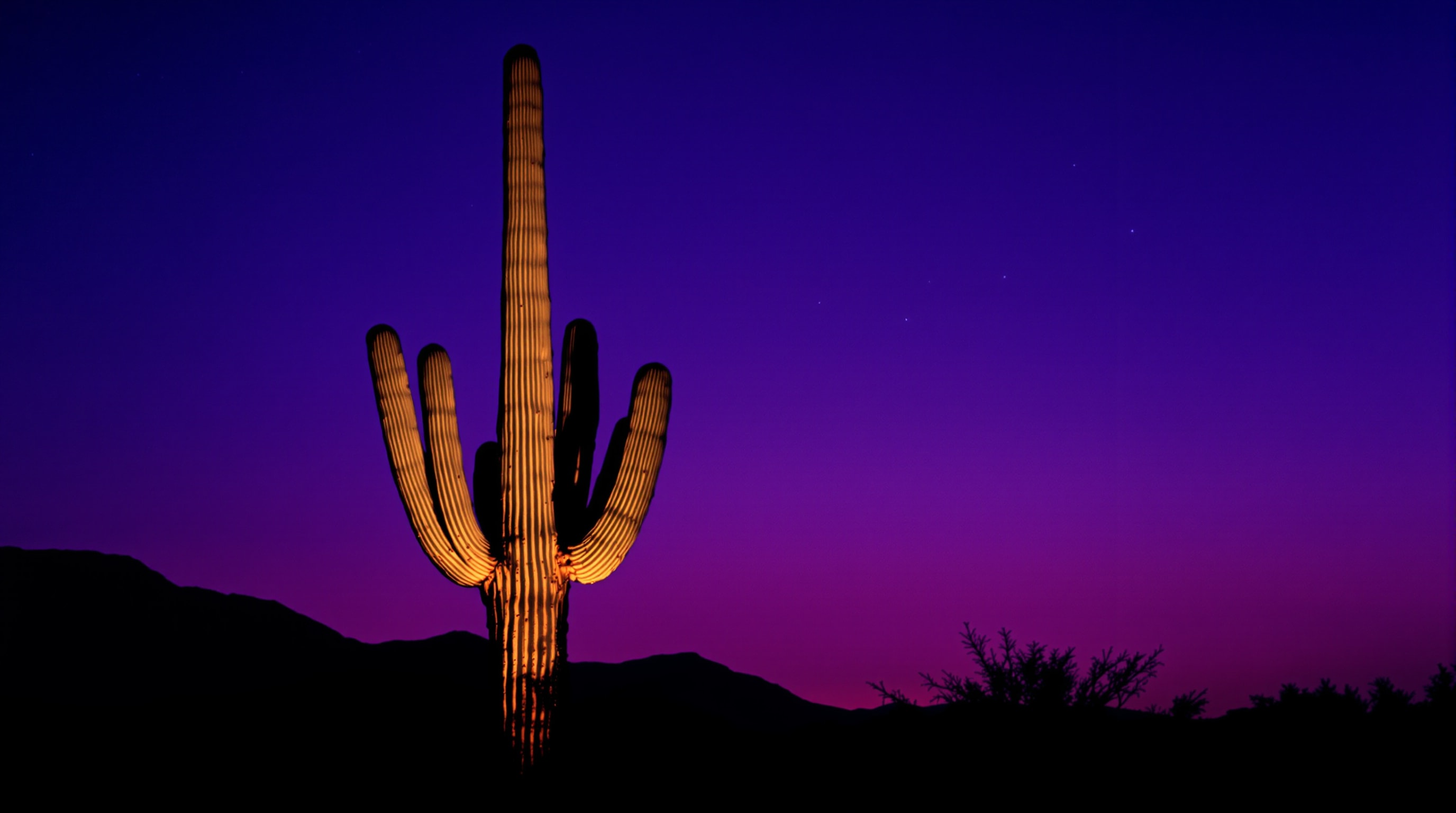
The Sonoran Desert is the most biologically rich desert in North America, which surprises people who expect scarcity to mean emptiness. It is not empty. It is full of organisms that have each solved the same problem — long unreliable dryness punctuated by brief abundance — in strikingly different ways, and the solutions generalise further than they have any right to.
The saguaro: reserves, and the price of them
The saguaro is the emblem of the region and an object lesson in patience. It grows extremely slowly at first — a specimen may take many years to reach ankle height, and decades before its first branching arm. The National Park Service describes the arc plainly: decades of slow early growth, great longevity, and a plant capable of storing an enormous volume of water inside a pleated structure that expands after rain and contracts through the dry months.
Two things are worth taking from that. The first is that the entire adult structure is a reserve system — the plant's strategy is not efficiency but storage, buying the ability to survive a bad year at the cost of growing slowly in good ones. The second is the vulnerability that implies: the young saguaro spends its most fragile decades under a nurse tree, sheltered from sun and frost, and a great many never make it out from under. High-reserve, long-lived strategies have an extended period during which they look like nothing at all and can be destroyed almost casually. That is the biological version of the compounding problem in Long Horizons.
Ephemerals: timing over persistence
The opposite strategy sits in the same soil. Desert ephemerals wait as seed — sometimes for years — and then germinate, flower and set seed in a matter of weeks when the right combination of rain and temperature arrives. In a good year they carpet the ground. In a bad one they simply do not appear, and lose nothing by it.
The insight is that waiting is an active strategy, not a failure to act. The seed is not idle; it is holding an option, and the entire value of the approach lies in not spending it during a false start. Ephemerals that germinated on the first modest rain would die. Anyone who has held cash through an overheated market, or declined a customer who would have consumed the business, has run the same play.
Monsoon: the shape of arrival
Southwestern rain does not arrive as a gentle average. It arrives in a summer monsoon of violent, localised storms, and the ground receives more water in an hour than it can absorb. Much of it runs off. The National Weather Service documents the pattern each season, including the flash flooding that follows.
This is a lesson about the shape of good fortune. Resources frequently arrive in bursts far larger than immediate capacity to use them, and what matters is whether anything was in place beforehand to capture the surplus. Land with intact vegetation and soil structure retains the storm; scoured ground sheds it and is further eroded by the same rain that enriched its neighbour. The windfall is identical. The infrastructure to hold it is not — and that infrastructure has to have been built during the dry years, when there was no evident reason to build it.
Nurse plants: shelter is the whole mechanism
Return to that young saguaro under its palo verde. The relationship is common across the desert: an established plant moderates temperature and light beneath its canopy, and a seedling that would die in the open survives there. The Arizona-Sonora Desert Museum treats the nurse relationship as one of the defining features of the region's ecology.
It is difficult to find a cleaner statement of the argument this initiative keeps making. The established organism spends very little — some shade it was producing anyway — and in exchange something that would otherwise have failed reaches maturity. Notably, the sheltered plant often outlives the shelter. That is mentorship, rendered in wood and thorn, and it is the ordinary mechanism by which the desert is populated at all.
Enough
The overall lesson is harder to state without sounding like a fortune cookie, so here is the flat version: in an environment where the limiting resource is genuinely limited, every organism's strategy is organised around the concept of sufficiency rather than maximisation. Nothing here grows as fast as it could. Everything is built to still be alive after the worst year in memory.
That is an unfashionable design principle and an extremely durable one. It is also, not coincidentally, how the most reliable businesses and the most stable communities in the region tend to be run — which is the connection Rooted in Arizona takes up.