Two towns of similar size lose their largest employer in the same year. A decade later one has recovered and the other has not. The difference is rarely explained by the shock itself, and almost never by anything either town did after it. It was decided beforehand, by structural features that looked like nothing much at the time.
Overlapping relationships
In a functioning community, any two people are connected through several channels at once. The person who fixes your truck is also on the same volunteer roster, and their sister sold you your house. These overlaps are usually described in sentimental terms. They are better understood as engineering: multiple independent paths between any two nodes.
The practical consequence is that things can be organised without formal machinery. When a road needs clearing or a family needs help, the coordination cost is close to zero, because the relationships and the trust already exist and do not have to be built under time pressure. A place with a single channel between people — everyone knows everyone else only through work, say — looks similar on the surface and behaves completely differently under stress. That structure cannot be assembled during a crisis. It is either there or it is not.
Repeated encounters
Trust is not primarily a moral achievement. It is a rational response to the expectation of meeting someone again. A contractor who will see their customer at the same shop every week for the next twenty years faces a very different incentive from one who will not, and both of them know it.
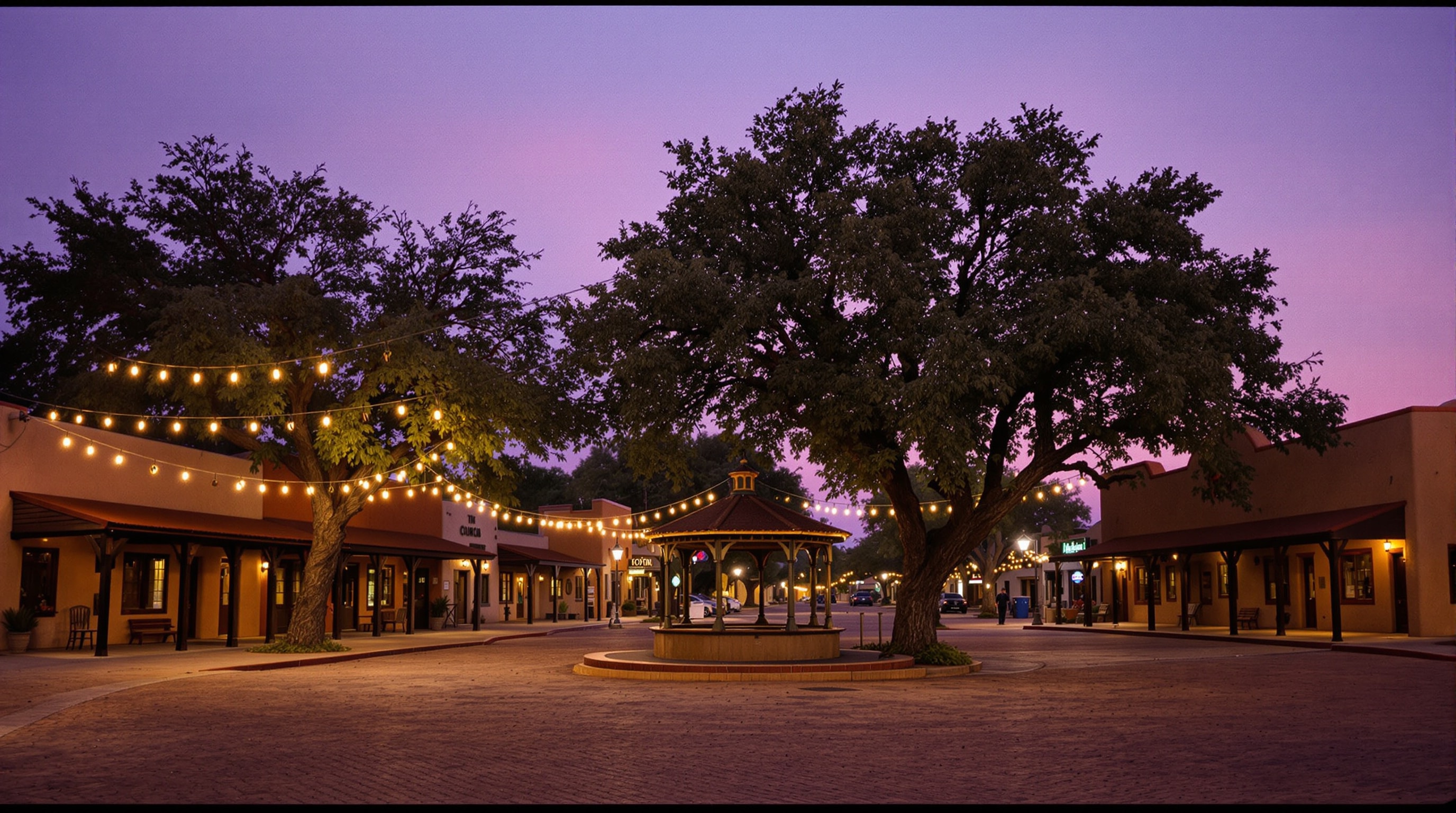
This is why the physical arrangement of a place has consequences that seem out of proportion to it. Somewhere that people pass through on foot generates incidental repeat encounters; somewhere that they drive between sealed destinations does not. Neither arrangement makes anyone a better person. One of them simply produces many more small occasions on which behaving well is also the sensible thing to do.
Buildings you can reuse
A durable town tends to have a stock of ordinary, adaptable buildings — modest floor plates, street frontage, structure that outlasts any particular use. Such a building might be a hardware store, then a print shop, then a café, then offices, across ninety years. Each transition is cheap, so each new venture starts with a low fixed cost, so more ventures get tried and the town keeps optioning its own future.
Purpose-built single-use structures are usually cheaper to build and enormously more expensive to convert. When their use ends, they sit empty, and the site is effectively withdrawn from the town's economy. The National Park Service's historic preservation programmes exist in large part because reuse of solid older building stock repeatedly turns out to be the cheaper path back to occupancy. The general principle is the one from Long Horizons: a decision that is cheaper on a five-year clock can be far more expensive on a fifty-year one.
People who stayed
Every recovered place has a handful of people who could have left and did not. They are usually running something — a business, a hall, a team — and they are usually the reason a given institution still exists, because at some point it came down to whether one specific person was willing to keep it going through several bad years.
Communities are not sustained by the average resident. They are sustained by a small number of disproportionately committed individuals, most of whom are unrecognised and some of whom are quietly resented for being everywhere. The relevant question for anyone who wants to be useful is not how to organise a broad movement. It is whether the four people currently holding the place together have any help.
Where the data helps, and where it doesn't
Some of this is measurable. Population, business formation, housing stock and commuting patterns are tracked in detail by the American Community Survey, and the numbers will tell you reliably whether a place is gaining or losing people and jobs.
What they will not tell you is the thing that determines the outcome: how many overlapping ties exist, who is holding which institution together, and whether the empty building on the corner has a roof worth saving. Those are visible in an afternoon on foot and invisible in a dataset — which is a reasonable summary of why place-specific knowledge keeps mattering.